Jump to main content

News

Print this page

Thalidomide

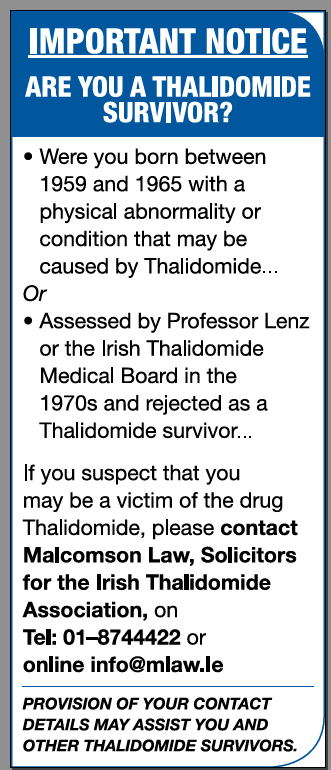
The Irish Thalidomide Association are seeking justice for those affected by the use of Thalidomide in the late fifties and early sixties. They are also seeking openness and transparency from the Irish Government and an acknowledgement of the wrong that occurred. In addition an apology from the Irish Government has been sought together with fair and equitable compensation.

In Ireland there are 32 survivors of the Thalidomide tragedy who are now approaching their fifties, many or all of whom are suffering with rapidly deteriorating health and disabilities that are usually seen in people much older.

The ITA engaged in discussions with the Minister for Health and Children almost three years ago in relation to the fairness and adequacy of an arrangement entered into on their behalf in 1975, yet a comprehensive response is still awaited. During this time, they have witnessed a complete revision of the arrangements in other jurisdictions.

In December 2009, the British Government delivered an apology to those affected by Thalidomide in Britain, yet the Irish Government still fails to acknowledge that a wrong occurred. The ITA have also recently been refused access to Cabinet documentation surrounding the tragedy, despite the fact that almost fifty years have elapsed since Thalidomide was withdrawn from the market.

Currently, the ITA's request for fair and equitable compensation is being reviewed by the State Claims Agency. A report is expected to be delivered later this month, but the ITA are dissatisfied with the total lack of input that has occurred.

What is Thalidomide?

Thalidomide was produced by the German pharmaceutical company Chemie Grunenthal in 1957. It was subsequently licensed for prescription by the Irish Government in 1959 and was prescribed as a sedative to expectant mothers to treat morning sickness and insomnia. Notably, Thalidomide was not licensed in other jurisdictions such as France or the United States.

After the drug came onto the market, a number of children were born with birth deformities including shortened limbs or in some cases no limbs, internal organ damage, deafness, nerve damage and numerous other complications, many women miscarried or babies dies at birth. Such incidents were later attributed to the use of Thalidomide and the drug was withdrawn from the market in 1961.

However, the withdrawal of the drug was not publicised effectively as it was considered that it would cause concern to pregnant women who had already taken Thalidomide. Therefore, in some areas in Ireland, Thalidomide remained on the market for several months after the Irish Government became aware of the dangers associated with the use of Thalidomide.

For more details, please visit click here.

This news section contains stories of interest from publicly available news sources. Where we are representing the clients referred to in the news material we will say so. Where we do not represent individuals or bodies mentioned or quoted, the inclusion of the news story in our news section is not intended nor should it be taken to imply that we act for the individual or body concerned.

Your Comments

If you would like to add a comment to this article, please fill in the form below. Your comment will need to be approved by a moderator before being added to this page.


News Search